Complete Chicago Roof Replacement Guide (2026)
Everything a Chicago homeowner needs to know before replacing a roof — real 2026 costs, material comparisons for Chicago climate, permit requirements, contractor selection, and the insurance claim process. This is the long-form reference; for deeper coverage on specific topics, follow the linked articles in each section.
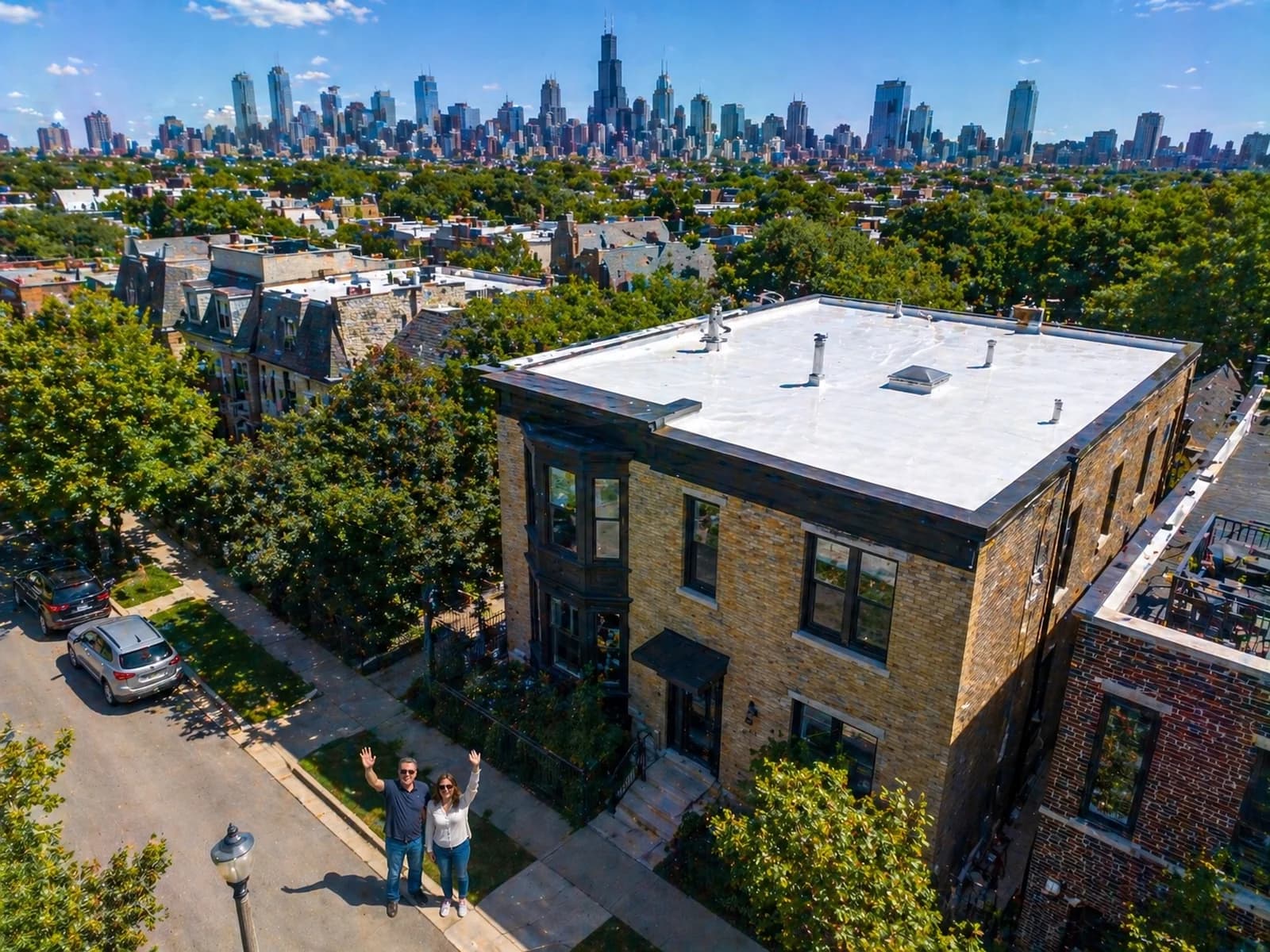
- Market average: $22,500 (all materials)
- Typical range: $10,000–$46,000
- Asphalt 2,000 sq ft: $16,000–$20,000
- Architectural 2,000 sq ft: $19,000–$26,000
- Metal 2,000 sq ft: $24,000–$46,000
- Flat roof (two-flat): $14,000–$22,000
- Chicago permit: $165–$550
- License verification: idfpr.com
How much does roof replacement cost in Chicago?
The average roof replacement in Chicago costs $22,500 in 2026, with a typical range of $10,000 to $46,000. For a standard 2,000 sq ft single-family home with asphalt shingles, expect $16,000 to $20,000. Architectural shingles run $19,000 to $26,000, metal roofing $24,000 to $46,000, and flat TPO or EPDM roofs $10,000 to $25,000. All estimates include labor, materials, the City of Chicago permit, and debris disposal. For the full breakdown by size and ZIP code, see our average cost article.
Chicago prices run 10–15% above the national average because of local labor rates, permit requirements, and the predominance of two-flats and three-flats that require flat-roof installation. Five factors move the final number: roof size, pitch, material choice, number of existing layers, and ZIP code.
By material
- Asphalt shingles: $10,000–$22,000 for a typical home. Most common material. See our asphalt shingle cost page.
- Architectural shingles: $19,000–$26,000 for a 2,000 sq ft home. Chicago climate default. See the architectural shingles page.
- Metal (standing seam): $30,000–$44,000; metal shingles $24,000–$36,000. Lasts 40–70 years. See the metal roof page.
- Flat roof (TPO/EPDM): $10,000–$25,000. Standard for two-flats and three-flats. See the flat roof page.
Chicago roofing materials compared
Four materials cover almost all Chicago residential roofs. The right choice depends on the building type, how long you plan to stay, and your budget.
Architectural asphalt shingles
The default recommendation for Chicago single-family homes. Cost $9.50–$13.00 per sq ft installed, lasts 20–25 years in the Chicago climate, and handles freeze-thaw cycles and moderate wind well. Class 4 impact-resistant versions cost 10–15% more but may qualify for a 10–35% insurance premium discount from Illinois carriers, often paying back the upgrade within 4–6 years. Avoid basic 3-tab shingles — their real-world lifespan in Chicago winters rarely exceeds 15–18 years.
Metal roofing
The longest-lasting option at 40–70 years. Standing seam steel runs $15.00–$22.00 per sq ft installed. Metal sheds snow naturally, reducing ice dam formation during Chicago winters. The payback versus asphalt is 15–20 years, which means metal is the right financial choice primarily for homeowners who plan to stay long term. Upfront cost is 2–3× asphalt; lifetime cost per year is comparable or lower.
Flat roof (TPO and EPDM)
Required on the two-flats, three-flats, and courtyard buildings that dominate Chicago's housing stock. TPO membrane is the current code-preferred system at $14,000–$22,000 for a typical two-flat, with a 25–35 year lifespan. EPDM rubber is the lower-cost alternative at $10,000–$22,000, lasting 15–25 years. Modified bitumen is a third option common on older buildings at $10,000–$20,000. Both TPO and EPDM need annual inspection of seams and drains.
For a side-by-side comparison with pros, cons, and Chicago-specific performance data, see our roofing materials comparison guide and the deeper best materials for Chicago article.
Repair vs. replacement: when do you need a new roof?
Replace your roof when it is 20 or more years old with asphalt shingles, when more than 30% of shingles show damage or granule loss, when you see daylight through attic boards, when multiple leaks appear in different areas, or when repair costs exceed 40% of full replacement. A single isolated leak on a roof under 10 years old is almost always a repair. A roof over 20 years with multiple problem areas is almost always a replacement.
In Chicago, ice dams are a common source of confusion. If ice dams cause recurring water intrusion, the underlying issue is usually attic ventilation and insulation, not the shingles themselves — see our ice dams guide. For the full decision framework with specific diagnostic signs, see our repair vs replace guide. Most reputable Chicago contractors offer free inspections, so when in doubt, get one before deciding.
Chicago Building Code and permit requirements
Chicago Building Code has two rules that drive most replacement decisions:
- 14R-3-306 (25% rule): A full tear-off is required whenever more than 25% of the existing roof is being replaced. Partial recover is only allowed on limited repair work.
- Max 2 layers rule: Chicago code allows a maximum of 2 roofing layers. If your roof already has 2 layers, full tear-off is mandatory — adds $1,500–$2,500 to the project, or $3,000–$4,000 if 3 layers are present.
Code also requires Ice and Water Shield underlayment extending at least 24 inches past the interior wall line at eaves and in all valleys — essential for Chicago winters. Synthetic underlayment is required over the full deck. Attic ventilation minimums must be met. A licensed contractor handles all of this as part of a properly executed replacement; if these items are not itemized in your estimate, ask why.
How to choose a Chicago roofing contractor
Every roofing contractor working in Chicago must hold an active Illinois IDFPR license (225 ILCS 335). Illinois issues two types: Limited (residential up to 8 units) and Unlimited (all buildings). Verify the license number at idfpr.com before signing any contract. Confirm General Liability insurance of at least $250,000 and Workers Compensation coverage. Require a written workmanship warranty of at least 5 years — 10 years is the mark of a quality contractor.
Get at least two itemized written estimates. Price differences of $2,000–$4,000 for identical scope are common in the Chicago market. Any bid more than 20% below the others usually means substandard materials, unlicensed labor, or mid-project upcharges. Never pay full upfront. A reasonable deposit is 10–30%, balance on completion. Red flags include door-to-door solicitation after storms, out-of-state plates with no local address, and any offer to waive your insurance deductible — the deductible rebate is illegal under Illinois law (815 ILCS 513/18).
For the complete pre-signing checklist — license, reviews, warranty, red flags, and how to compare estimates — see our how to choose a contractor guide and how we rank companies.
Storm damage and insurance claims in Chicago
Homeowner insurance covers roof replacement in Chicago when damage is caused by a covered event — storm, hail, wind, or fallen tree limbs. It does not cover normal wear, aging, or deferred maintenance. The claim process in order:
- Within 48 hours: document damage with timestamped photos and video from the ground and (safely) from attic.
- Before calling the insurer: get a written damage assessment from a licensed local contractor. This documentation drives the scope and payout of your claim.
- File the claim: Illinois carriers typically set a one- to two-year deadline from the date of loss (215 ILCS 5/143.1).
- Adjuster visit: request that your contractor be present. Adjuster and contractor walking the roof together prevents most scope disputes.
- Deductible warning: many Illinois carriers now use percentage-based wind/hail deductibles of 1–2% of insured home value. A $400,000 home with a 1% deductible is $4,000 out of pocket, not the older flat $500–$2,500. Check your policy now, not after a storm.
Never sign over your insurance benefits (an "AOB" assignment) or let a contractor waive your deductible. Both practices are illegal in Illinois and can void coverage. For the complete step-by-step insurance process, see our storm damage guide.
Best time of year to replace a roof in Chicago
November through April is off-peak season in Chicago, and contractors often discount 10–15% off peak rates. Demand drops sharply after the fall rush, which means crews are available and contractors are more willing to lock in work at lower margins. Reputable companies use cold-weather adhesives and follow manufacturer guidelines for low-temperature installation, so off-peak installation is not inferior. Peak season (May–October) adds about 10% to base prices.
Avoid scheduling immediately after a major hailstorm: post-storm demand spikes push prices up and extend lead times by weeks. The best value windows are late March, April, early May, late September, and October. For more ways to reduce total cost, see how to save money on roof replacement.
Chicago neighborhoods: pricing by area
Roof replacement costs vary meaningfully by area of Chicago, driven by labor access, building age, building type, and historic architecture requirements:
- North Side (Lincoln Park, Lakeview, Andersonville): $12,000–$43,000. Historic greystones, premium materials, +12% zone.
- Northwest Side / Bungalow Belt (Portage Park, Jefferson Park, Norwood Park): $11,000–$40,000. Classic Chicago bungalows, mostly asphalt and architectural shingles.
- South Side (Hyde Park, Bridgeport, Beverly): $10,000–$46,000. Brick bungalows and two-flats.
- West Side (Humboldt Park, Pilsen, Austin): $10,000–$46,000. Older brick buildings, many flat roofs.
- Southwest Side (Beverly, Roseland): $10,000–$46,000.
North Side ZIPs (60614 Lincoln Park, 60613 Lakeview, 60611 Gold Coast) consistently run about 12% above the city average. This is driven by labor access, narrow streets and parking restrictions that slow crews, and a higher share of architectural shingles and metal. South Side and West Side pricing is closer to the baseline average.
Common mistakes Chicago homeowners make
- Waiting too long. A roof with active leaks over one or two seasons often rots the decking — adds $500–$2,000 to the project when new shingles need new decking underneath.
- Skipping the Chicago permit. Saves nothing upfront, creates problems at resale and during insurance claims. Unpermitted work is a deal-killer on disclosure forms.
- Taking the lowest bid without verification. A bid 20%+ below others usually signals unlicensed labor or substandard materials. The difference shows up in year 3–5.
- Signing an AOB (Assignment of Benefits) after a storm. Gives the contractor control of your claim and has led to thousands of Illinois complaints. Never sign one.
- Accepting a deductible waiver. Illegal under 815 ILCS 513/18. Even when offered sincerely, accepting one can void your insurance coverage.
- Not documenting storm damage within 48 hours. Insurers reject claims where damage cannot be tied to a specific weather event.
- Ignoring gutters and ventilation. Clogged gutters and inadequate attic ventilation are the two biggest drivers of premature roof failure in Chicago, forcing ice behind shingles during freeze-thaw cycles.
- Choosing 3-tab over architectural to save a few thousand dollars. The real-world lifespan difference in Chicago is often 5–8 years — making architectural the clearly better value.
- Hiring storm chasers. Out-of-state crews that appear after major hailstorms are usually gone by the time warranty issues surface. Always verify license at idfpr.com.
- Not getting the workmanship warranty in writing. Verbal warranties are worthless. Require 5 years minimum, 10 preferred, specifically on installation.
Frequently asked questions
Ready to get estimates for your Chicago roof replacement? Our advisors connect you with licensed, pre-verified local contractors.
CALL NOW (844) 578-0719Free consultation. No obligation. 7 days a week.